
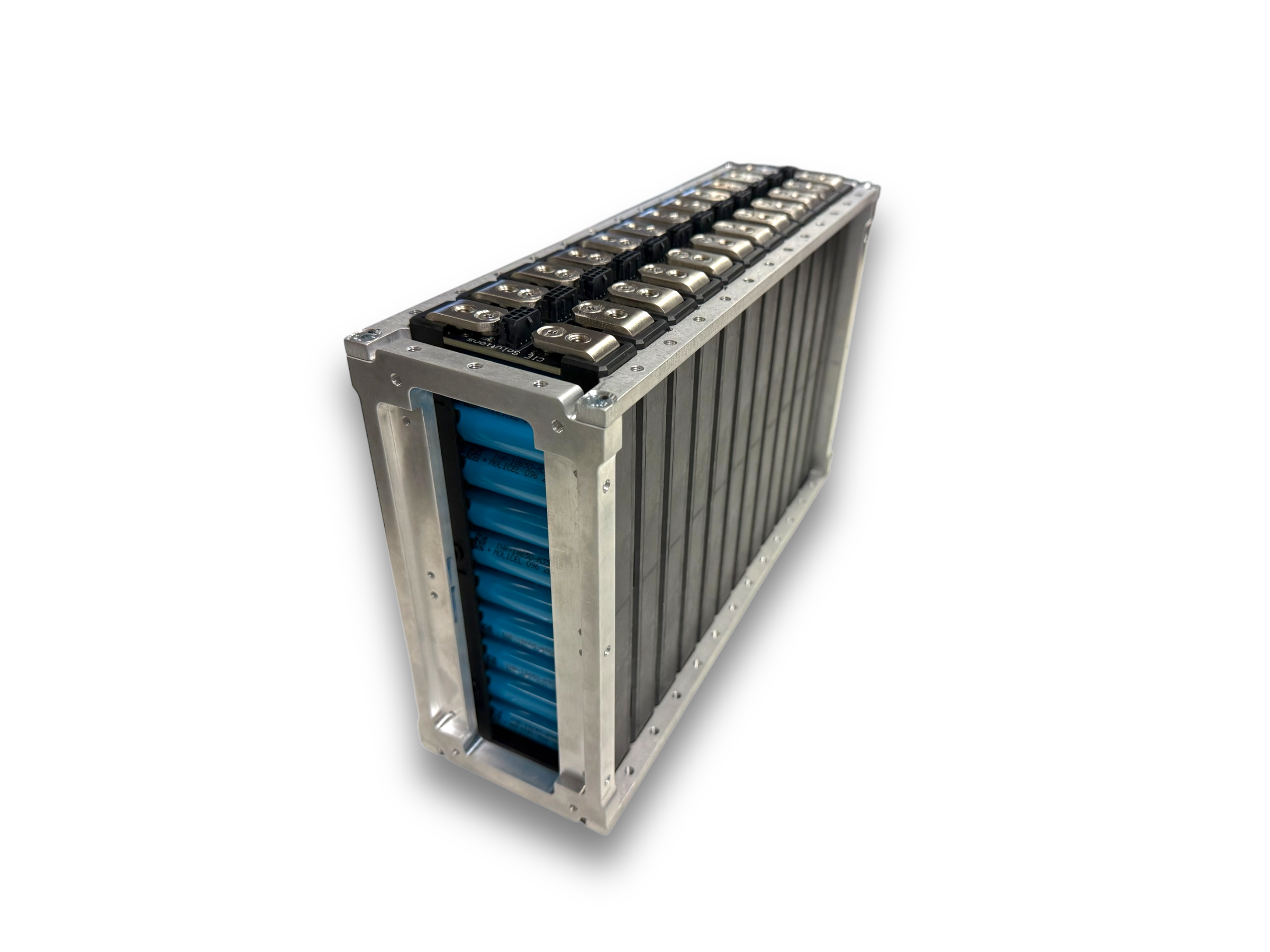
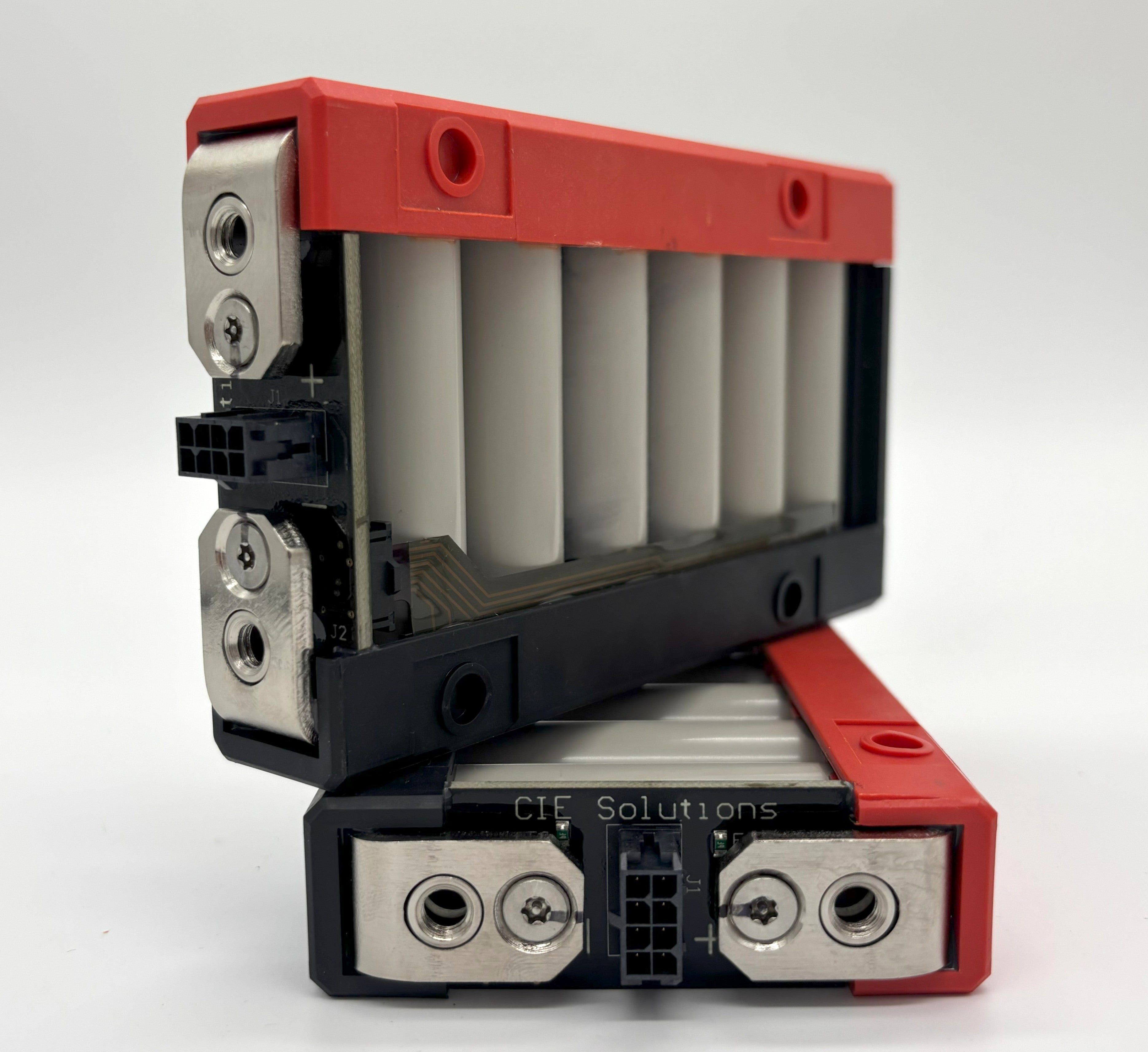
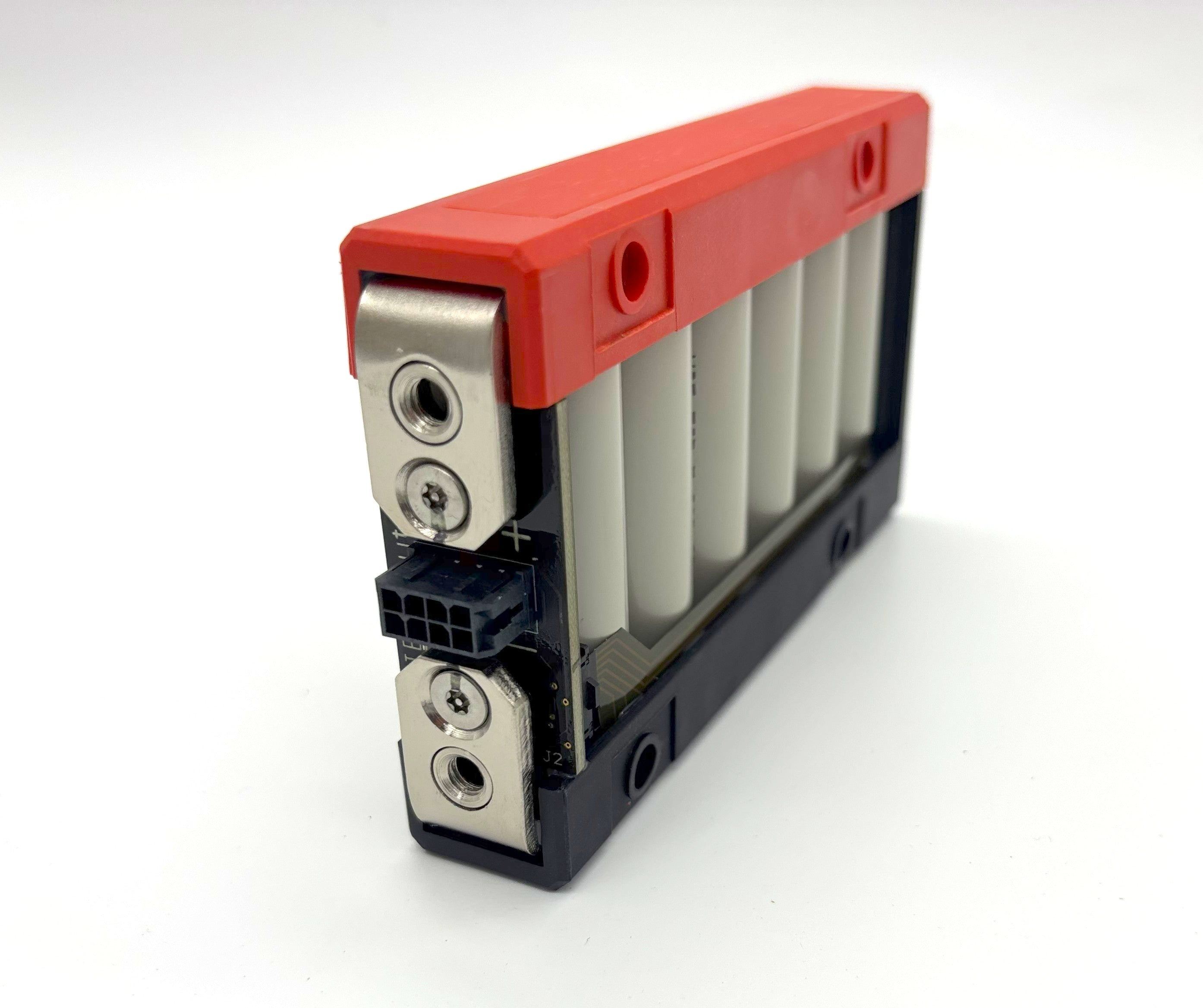
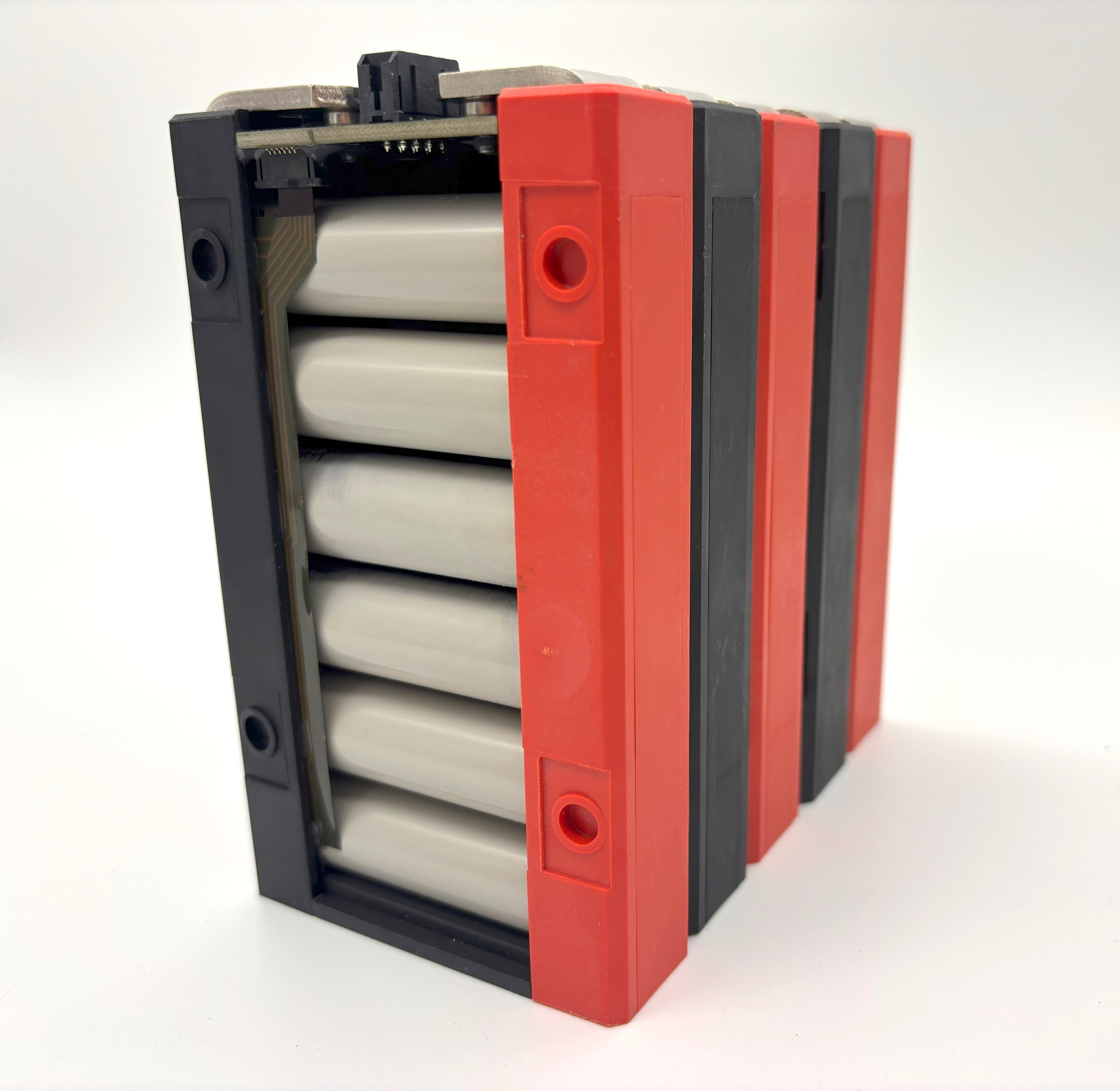
Wire-Bonded 18650 Lithium-Ion Module · 1S · 5P to 10P · Air-Cooled
Lithium Block™ GEN2
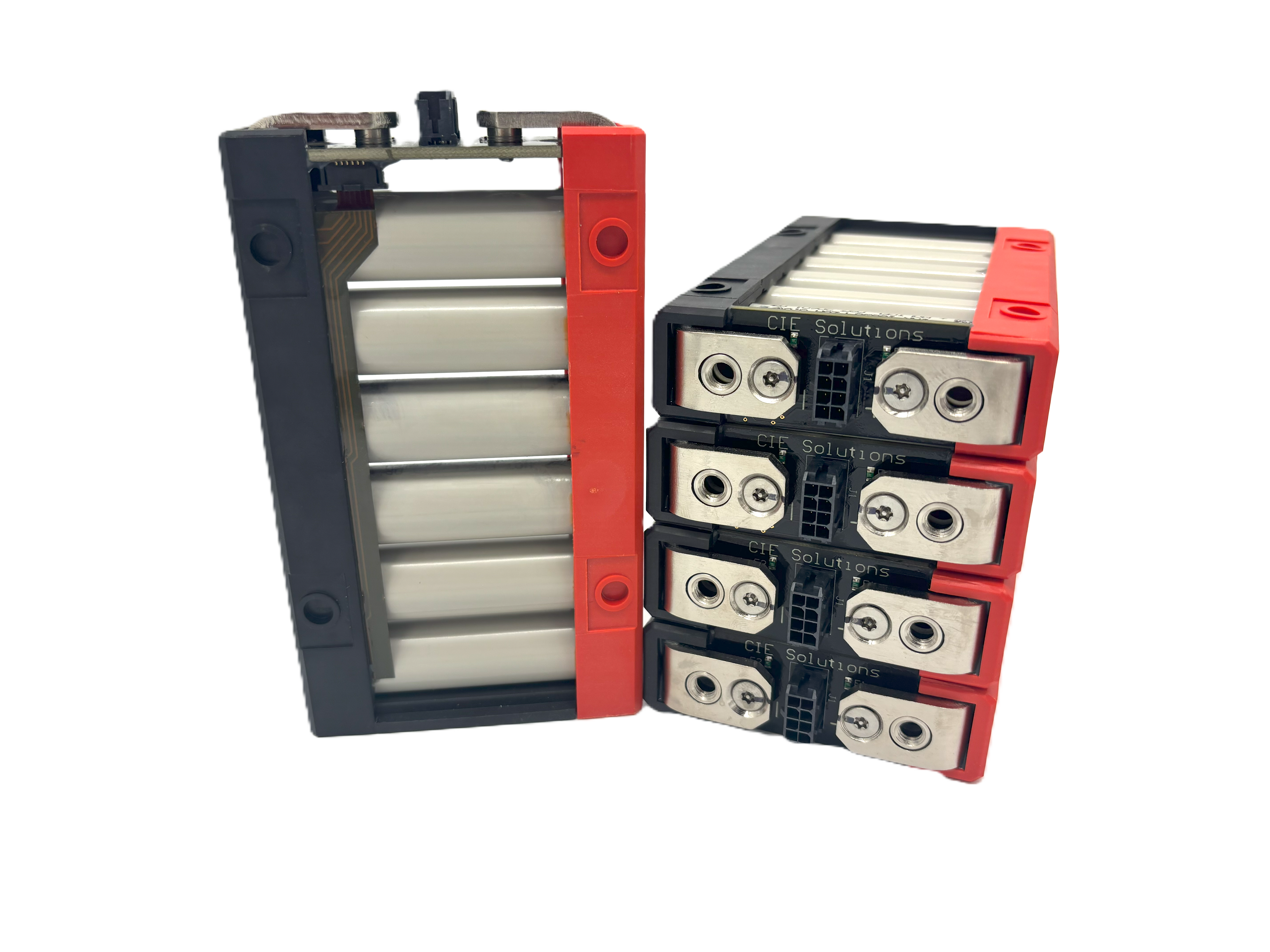
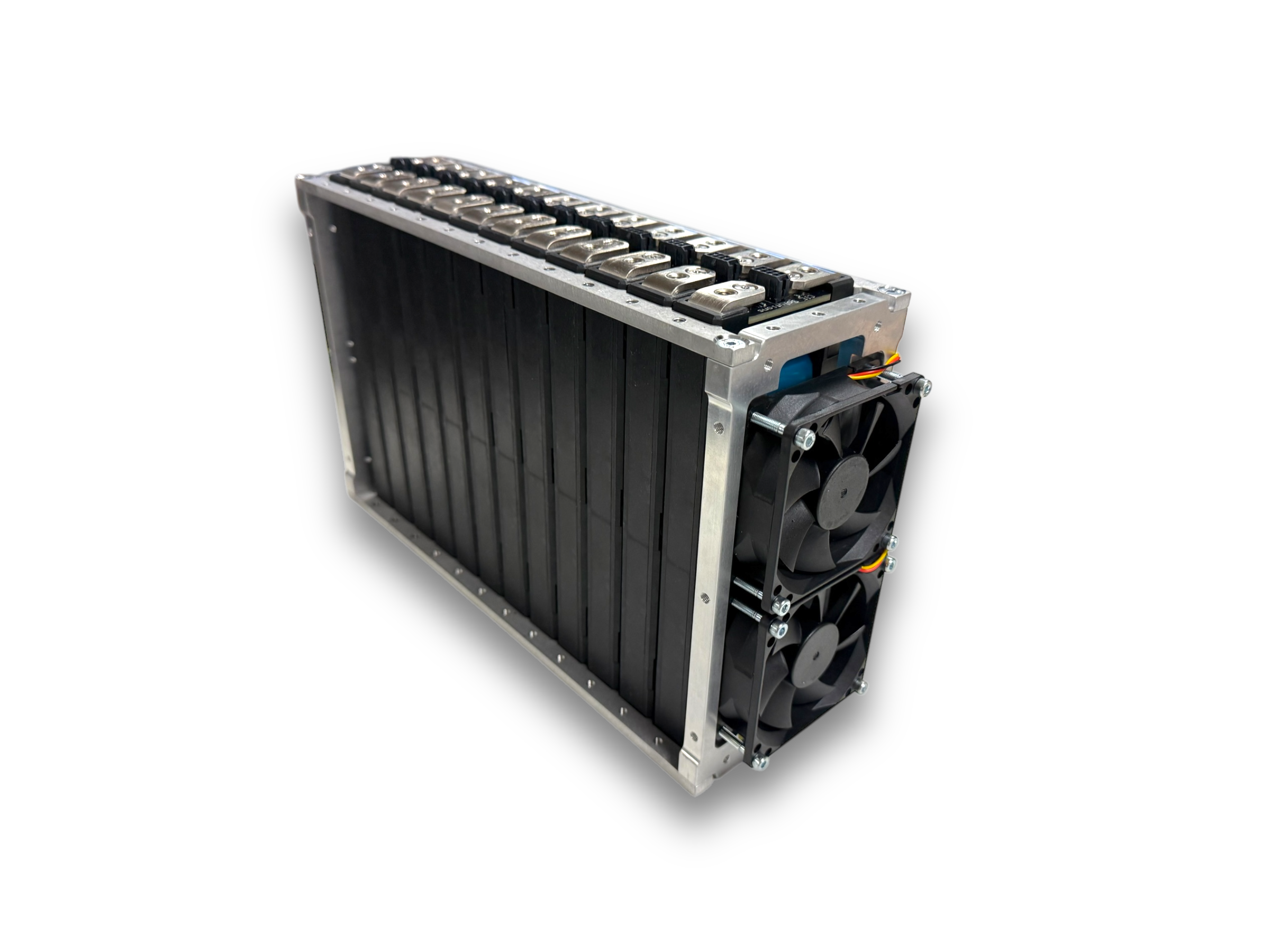
A compact, pack-ready battery module built on ultrasonic wire-bonding. Connectorized cell voltage and temperature sensing on an FR4 PCB, resettable sense fusing, and integrated M6 busbar threading. Engineered for repeatable assembly from prototype through production.
† 10P Power Module, Performance (copper collector plates). Power Module, Standard (aluminum collector plates): 175 A (5P), 210 A (6P through 10P). Energy Module max discharge: 50 to 100 A by variant. Allowable current depends on your system: thermal path, busbars, wiring, and duty cycle.
Energy Module Molicel M35A
Optimized for capacity and cycle life. Applications include energy storage, long-duration discharge, and range-focused electric vehicles.
| Parameter | 5P | 6P | 7P | 8P | 9P | 10P |
|---|---|---|---|---|---|---|
| Part Number | LBG2-05E | LBG2-06E | LBG2-07E | LBG2-08E | LBG2-09E | LBG2-10E |
| Capacity | 17.5 Ah | 21 Ah | 24.5 Ah | 28 Ah | 31.5 Ah | 35 Ah |
| Energy | 63.0 Wh | 75.6 Wh | 88.2 Wh | 100.8 Wh | 113.4 Wh | 126.0 Wh |
| Voltage (nom / max / min) | 3.6 V / 4.2 V / 2.5 V | |||||
| Max Charge Current | 8.5 A | 10.2 A | 11.9 A | 13.6 A | 15.3 A | 17 A |
| Max Discharge Current | 50 A | 60 A | 70 A | 80 A | 90 A | 100 A |
| Length (approx.) | 118.4 mm | 138.4 mm | 158.5 mm | 178.5 mm | 198.6 mm | 218.7 mm |
| Mass | 317 g | 374 g | 431 g | 487 g | 544 g | 601 g |
Power Module, Standard Molicel P28A
Optimized for high discharge and fast charging. Applications include high-performance EVs, FSAE, power tools, and aerospace platforms. Aluminum 5052-H32 collector plates, EN plated. Collector ampacity limit: 210 A.
| Parameter | 5P | 6P | 7P | 8P | 9P | 10P |
|---|---|---|---|---|---|---|
| Part Number | LBG2-05P | LBG2-06P | LBG2-07P | LBG2-08P | LBG2-09P | LBG2-10P |
| Capacity | 14 Ah | 16.8 Ah | 19.6 Ah | 22.4 Ah | 25.2 Ah | 28 Ah |
| Energy | 50.4 Wh | 60.5 Wh | 70.6 Wh | 80.6 Wh | 90.7 Wh | 100.8 Wh |
| Voltage (nom / max / min) | 3.6 V / 4.2 V / 2.5 V | |||||
| Std Charge / Max Charge | 14 / 30 A | 16.8 / 36 A | 19.6 / 42 A | 22.4 / 48 A | 25.2 / 54 A | 28 / 60 A |
| Max Discharge Current | 175 A | 210 A | 210 A | 210 A | 210 A | 210 A |
| Collector Plate | Aluminum 5052-H32, 0.125 in (3.18 mm), EN plated | |||||
| Length (approx.) | 118.4 mm | 138.4 mm | 158.5 mm | 178.5 mm | 198.6 mm | 218.7 mm |
| Mass | 317 g | 374 g | 431 g | 487 g | 544 g | 601 g |
Power Module, Performance Molicel P28A · Copper Collector
C11000 copper collector plates. Collector ampacity limit: 357 A. Unlocks the full discharge capability of the Molicel P28A cell (35 A per cell). Available in 7P through 10P.
| Parameter | 7P | 8P | 9P | 10P |
|---|---|---|---|---|
| Part Number | LBG2-07P-CU | LBG2-08P-CU | LBG2-09P-CU | LBG2-10P-CU |
| Capacity | 19.6 Ah | 22.4 Ah | 25.2 Ah | 28 Ah |
| Energy | 70.6 Wh | 80.6 Wh | 90.7 Wh | 100.8 Wh |
| Voltage (nom / max / min) | 3.6 V / 4.2 V / 2.5 V | |||
| Std Charge / Max Charge | 19.6 / 42 A | 22.4 / 48 A | 25.2 / 54 A | 28 / 60 A |
| Max Discharge Current | 245 A | 280 A | 315 A | 350 A |
| Collector Plate | C11000 copper (ETP), 0.125 in (3.18 mm) | |||
| Length (approx.) | 158.5 mm | 178.5 mm | 198.6 mm | 218.7 mm |
| Mass | 468 g | 532 g | 596 g | 660 g |
Module currents reflect cell capability. Allowable current depends on your system (thermal path, busbars, wiring, duty cycle). Wire-bond fuse rating: ~58 A/bond (Power), ~30 A/bond (Energy), median.
Module Overview
Electrical
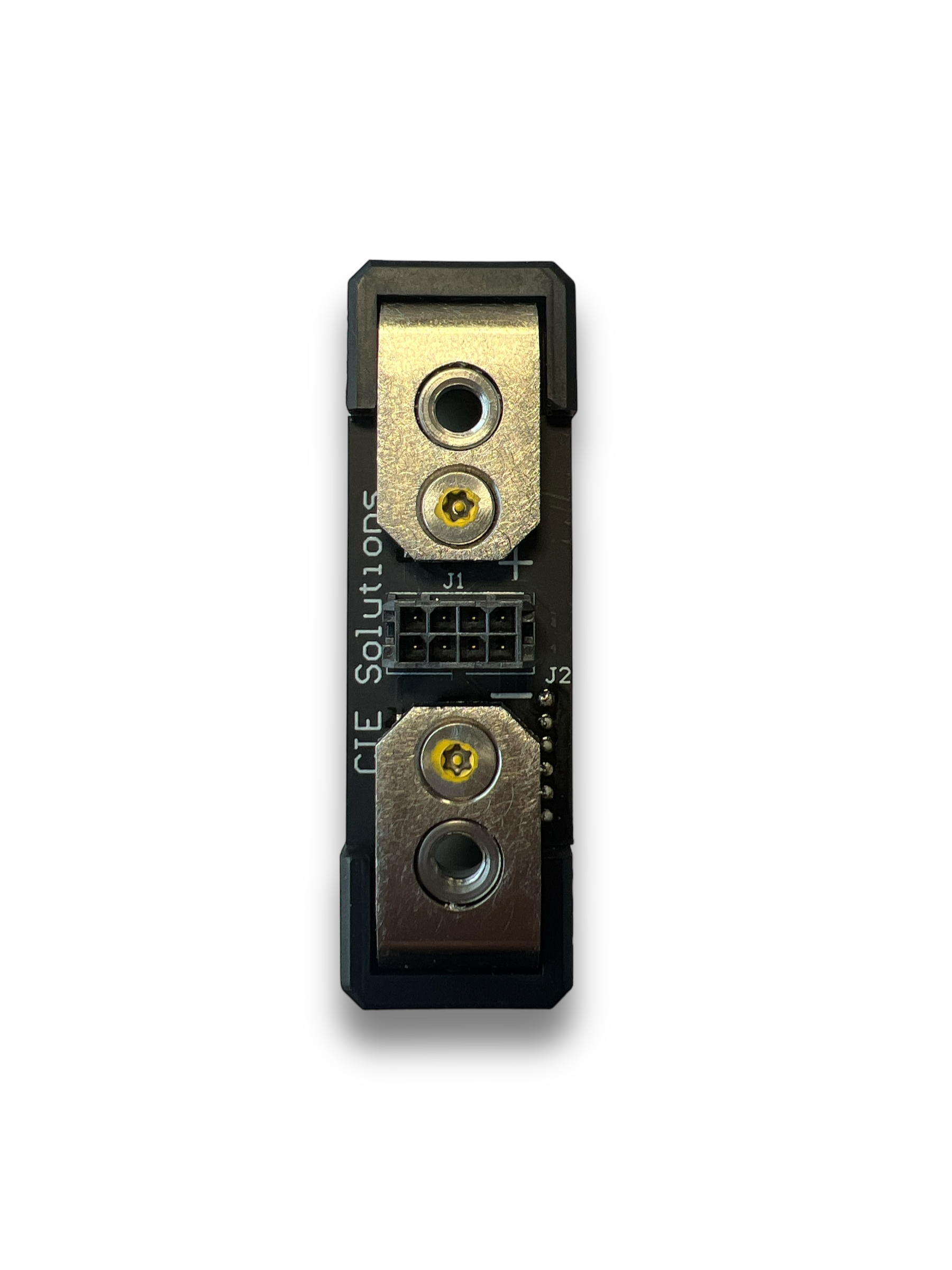
- Sense Connector
- Molex 430450812, 8-pin (mate 43025-0800, crimp 43030-0007)
- Sense Fusing
- PTC resettable, 200 mA per line
- Thermistors
- 10 kΩ ±0.5% NTC, β 3380 K ±1%
- Thermistor Count
- 3 (5P/6P) · 4 (7P through 9P) · 5 (10P)
- HV Terminals
- M6 × 1 threaded insert (PennEngineering F-M6-3), 300 Series SS, 3.05 mm usable engagement
- HV Terminal Torque
- 5.5 Nm with Loctite 243 (stick, not liquid)
- Max System Voltage
- 500 Vdc (conductor spacing per IEC 60664)
Mechanical
- Cross-Section (H × W)
- 80.75 × 25.5 mm (fixed)
- Length
- 118.4 to 218.7 mm (varies by parallel count)
- Housing
- 15% glass-filled ABS, UL94 V-0 rated resin (thickness-dependent)
- Collector Plate
- Standard: aluminum 5052-H32, EN plated (210 A). Performance: C11000 copper (357 A). Both 0.125 in (3.18 mm).
- Bus Bar Hole Spacing
- 25.5 mm center-to-center
Wire-Bond Technology
Every cell-to-collector connection is made with ultrasonic wire bonding, a solid-state process that creates metallurgical bonds without melting metal. No spatter, no flux, no heat damage to cells.
Built-In Fusing
Individual bonds act as fuses under overcurrent. A single bond failure doesn't propagate; the module degrades gracefully instead of failing catastrophically.
Repeatable Quality
Automated bonding with inline pull/shear testing to MIL-STD-883, statistical process control, and full traceability on every module.
Low Resistance
Wire bonds produce consistently low-resistance connections with excellent fatigue life under thermal cycling and vibration.
What Changed in GEN2
GEN2 adds an FR4 PCB and connectorized interface that GEN1 doesn't have. If you're designing a new pack, start here.
Connectorized Cell Telemetry
Cell voltage and temperature sensing routes through an FR4 PCB, terminating in a single 8-pin Molex connector. Cleaner data, faster harness assembly, fewer failure points than flying leads.
Resettable Sense Fusing
PTC fuses on every voltage sense line protect the monitoring circuit without requiring service to replace blown fuses. The sense path resets automatically after a fault clears.
HV Busbar Mounting
Integrated M6 threaded inserts on the module for direct busbar attachment. Rigid, repeatable connections without floating nuts or adhesive-mounted hardware.
IPC Class II PCB
The GEN2 board is manufactured and inspected to IPC Class II standards with creepage/clearance per IEC 60664.
Integration & Accessories
BMS Compatibility
Works with any BMS supporting individual cell voltage monitoring and 10 kΩ NTC inputs. Fully compatible with Orion BMS products, available from EVolve.
Available Separately
Bus bar integration kit (BUS-LB), including mounting hardware, and the Lithium Block bracketing system.
Safety & Compliance
| Standard | Scope | Level |
|---|---|---|
| UN 38.3 | Transport safety | Module level, test report available |
| IEC 62133 | Cell safety | Cell level, manufacturer certified |
| UL94 V-0 | Housing flammability | Resin rating (thickness-dependent) |
| IEC 60664 | Conductor spacing | Module, designed to standard |
| IPC Class II | PCB manufacture | Module, GEN2 FR4 PCB |
| UL 1973 / IEC 62619 / ISO 12405 | System-level | Pack integration required |
System-level certifications (UL 1973, IEC 62619, ISO 12405) are achieved at the pack or vehicle level and are the responsibility of the system integrator. RoHS compliant. No REACH SVHCs. Responsible mineral sourcing.
Downloads
CAD Models (STEP)
Frequently Asked Questions
What cells does the Lithium Block GEN2 use?
Energy Modules use the Molicel M35A (3.6 V nominal, 3.5 Ah per cell). Power Modules use the Molicel P28A (3.6 V nominal, 2.8 Ah per cell). All cells are procured directly from the manufacturer and individually tested before integration.
What is the difference between Energy and Power modules?
Energy Modules maximize capacity and cycle life, delivering up to 35 Ah and 126 Wh with max discharge up to 100 A. Power Modules maximize discharge rate: up to 210 A max discharge with standard aluminum collector plates, or up to 350 A with Performance copper collector plates (7P through 10P), with fast-charge support up to 60 A. All variants share identical housing dimensions at each parallel count, so you can swap module types without changing your mechanical design. Performance modules are heavier; see the Power Module tables for mass.
What is wire bonding and why does it matter?
Ultrasonic wire bonding creates solid-state metallurgical bonds between cells without melting metal. Each bond acts as an individual fuse under overcurrent, so a single bond failure doesn't cascade into a catastrophic event. The process also produces lower thermal stress on cells during manufacturing, consistently low connection resistance, and is fully automated with inline quality testing to MIL-STD-883.
What BMS is compatible with the Lithium Block GEN2?
Any BMS that supports individual cell voltage monitoring and 10 kΩ NTC thermistor inputs will work. The GEN2 sense harness terminates in a Molex 430450812 connector (8-pin). Orion BMS products are fully compatible and available directly from EVolve.
What is the maximum system voltage?
The module supports pack architectures up to 500 Vdc. Conductor spacing on the PCB and within the housing is designed to IEC 60664 requirements. The module is intended for segmented pack designs where series strings build up to the target system voltage.
What accessories are available?
Two accessories are sold separately: the bus bar integration kit (BUS-LB), which includes mounting hardware, and the Lithium Block bracketing system.
Does the Lithium Block GEN2 have safety certifications?
Cells are IEC 62133 certified. Modules are tested to UN 38.3 for transport safety; test reports are available on request. The housing resin carries a UL94 V-0 flammability rating (thickness-dependent, per supplier datasheet). System-level certifications (UL 1973, IEC 62619, ISO 12405) are achieved at the pack or vehicle level by the integrator.

Designed & Assembled in Boulder, CO
EVolve Battery Systems is part of the EVolve family, in business since 2009. Straight pricing, reliable lead times, and real integration support.
Phone: (720) 414-5502 · Email: info@evolvebattery.us